风萧萧_Frank
以文会友



Carney's Diplomacy for a Changed World: 'Cometh the Hour, Cometh the Man'
This piece is part of our Policy Series: Carney's Canada One Year Later.
By Jeremy Kinsman April 20, 2026
https://www.policymagazine.ca/carneys-diplomacy-for-a-changed-world-cometh-the-hour-cometh-the-man/?
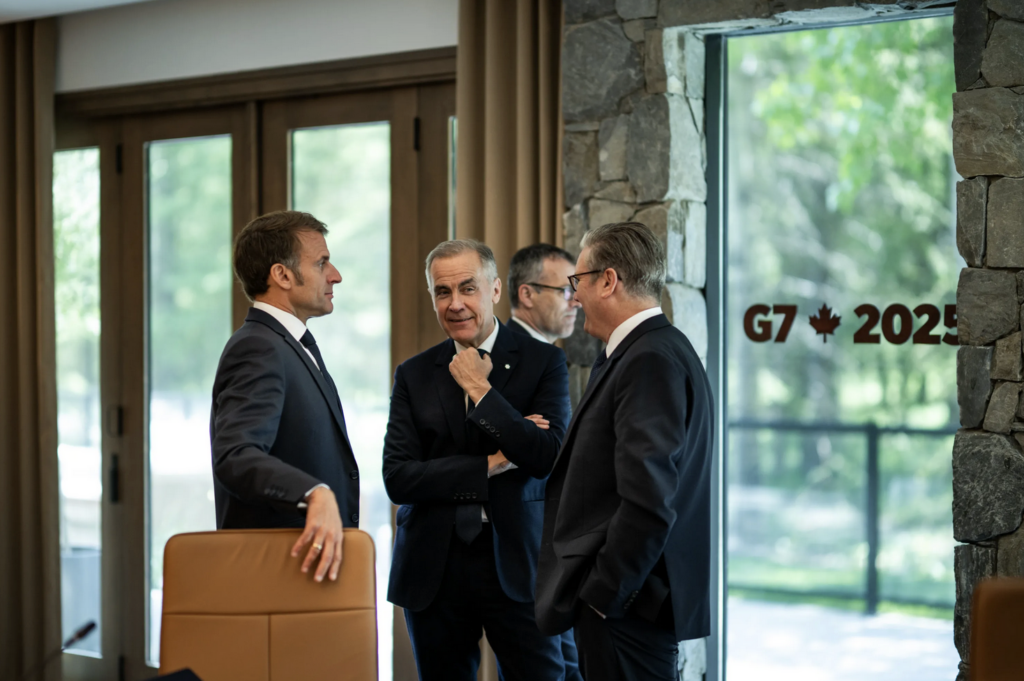 Prime Minister Mark Carney at the Kananaskis G7 in June, 2025/PMO
Mark Carney is the first prime minister of Canada thrust into office by an external threat.
Donald Trump’s repeated threats to annex Canada left Canadians disbelieving, outraged, and then very apprehensive. Weary of Justin Trudeau after a decade, they knew that a feminist foreign policy wasn’t going to counter the predatory and destructive impulses of the monster next door.
“There are some who say there’s no need for a comprehensive plan,” Carney said on April 19th in the first of what will be regular addresses branded Forward Guidance. “They believe we should wait it out in the hope that the United States will return to normal, that the good old days will come back.”
“But hope isn’t a plan, and nostalgia is not a strategy.”
When desperate Liberals turned massively to Carney — an internationally respected private financier and sought-after central banker — to replace Trudeau, some pundits doubted that he had the political chops.
But as a freshman retail politician, Carney came across as thoughtful, substantive, likeably natural, authentic as a Canadian, and an escape from the deluge of empty talking points in which our political discourse had become lost. Most of all, he convinced anxious Liberals and then Canadian voters that he knew where and how to lead us in our urgently needed national defence.
Carney’s week-by-week surge in the 2025 election campaign drew, for a Canadian, unprecedented attention in Europe and elsewhere. The former governor of the Bank of England’s record of competence in managing crises and obtaining stability was repeatedly recalled in the European press. His election win in Canada and the resurrection of the Liberals resonated in the democratic world as a reason to believe moderate, centrist politics could still appeal.
But the crucial story-making cachet appealing to Trump-shaken Canadian partners was that of a respected democracy’s front-line resistance to bullying and threats from the rampaging U.S. president. “We are all Canadians now,” wrote Bill Emmott, former editor of The Economist, in his old magazine.
He didn’t defend Canada from Trump’s threats and tariff coercion by pleading for a less-bad tariff deal from the U.S., hoping to buy predictability from a protection racket.
Building on the value of our unique expertise as a front-line target of Trump’s predation both economic and military, Carney embarked on a mission of consolidating countervailing power among rational, rule-of-law observing geopolitical partners.
As a result, over the past year, Mark Carney has become the face of Canada abroad, identified with both competence and security. He didn’t defend Canada from Trump’s threats and tariff coercion by pleading for a less-bad tariff deal from the U.S., hoping to buy predictability from a protection racket.
In his landmark speech at Davos, Carney declared that our longstanding “normal” was now irreparably ruptured by the U.S. under Trump; the postwar multilateral system of international rules, norms, and institutions created to govern trade, commerce, peace and security, and almost everything else was now shredded.
Carney has harnessed that crisis as the opportunity for Canadians to engage in a generational effort to strengthen national capabilities at home, while partnering more deeply and widely abroad. Carney’s frame for this imperative is his oracular assessment of the need to build middle-power coalitions of the willing to ensure that a cooperative world order survives America’s defection to the one dominated by predatory hegemons.
The Prime Minister is propelling a startling invigoration of foreign policy, forming a triad of transformative building at home, the recalibration of partnerships abroad, and globally, diplomatic stimulus to rebuild productive multilateral cooperation, along with specific subsets, such as reinvesting and revitalizing the military, and protecting and nurturing the Arctic.
In his keynote speech to the Liberal convention on April 11, Carney recalled Louis St. Laurent ‘s contribution as Foreign Affairs minister and prime minister. In 1947, St. Laurent laid out the principles of postwar Canadian foreign policy: to secure national unity, manage relations with the United States, and pursue “humanistic” purposes in the world, by providing “economic and moral force” to less fortunate nations of the emerging Global South.
Obviously, Carney intends Canada to prioritize management of relations with the U.S. as beneficially as possible, while trying to reduce our vulnerability and over-dependence.
As to St. Laurent’s promise of a “humanistic” global outlook, Carney is almost silent on Canadian commitment to urgencies of humanitarian assistance, and the enduring need of developmental aid, especially on climate-change mitigation, which seems to be paling as a policy priority.
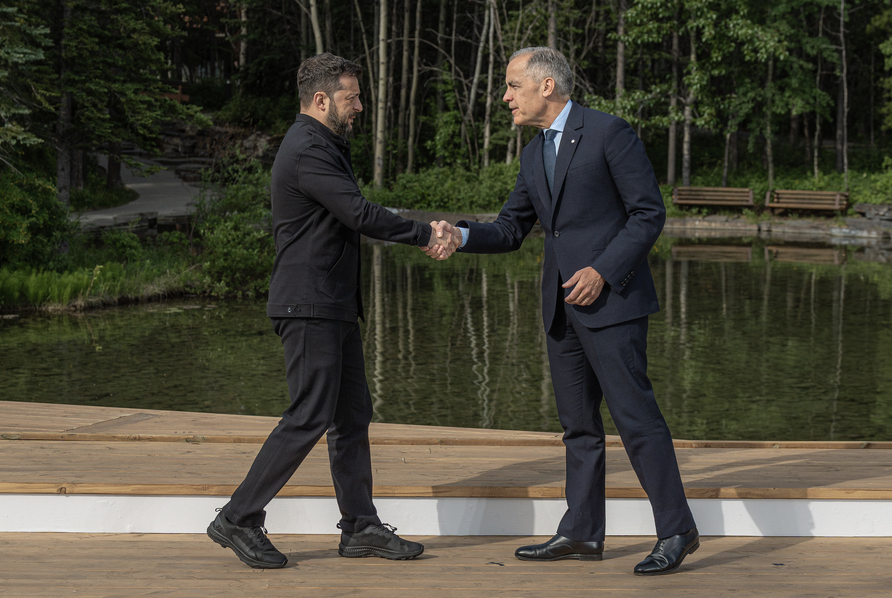 Mark Carney greeting Volodymyr Zelensky at the Kananaskis G7 in June, 2025/PMO
He has mightily increased spending on military defence while cutting the budget for development spending and Global Affairs Canada, limiting our soft-power branding abroad.
Carney has, however, spoken out after attacks on Iran (controversially, via a rolling response) and Lebanon, and the on the handling of Gaza, and of the need to respect international law, prompting rebuke from the Israeli government, with which bilateral relations have eroded.
Carney’s diplomatic agenda was evident when, after being sworn in as PM last March, he went immediately to London and Paris.
The month before, desperate to curry Trump’s favour amid an unjust tariff war, Keir Starmer had, during his Oval Office crucible, plucked from his breast pocket an invitation by King Charles for a second state visit by the anglophile American president.
In-between Starmer’s Trump bilateral and the president’s visit to London last September, Charles made his status as the only non-resident head of state with any role to play in Canada indisputably clear by delivering the Speech from the Throne in Ottawa at the end of May. He was greeted by Canadians with a euphoria unrivalled since his mother’s first visit as monarch in 1957.
It seems improbable that Carney and King Charles, whose paths of course crossed during the former’s seven years at the Bank of England, would not have acknowledged informally to each other the probability that Donald Trump had no idea when threatening to annex Canada that Charles is Canada’s head of state. After the powerful May tutorial on that technicality, the King no doubt mentioned it during Trump’s September audience.
The visit to Macron, to whom Carney had been an informal economic adviser, had historical resonance, but also cemented an alliance of minds on our geopolitical dislocation.
After a year of record-breaking prime ministerial travel that might be dubbed “variable-geometry diplomacy”, Carney has begun boasting of “20 new security partnerships on four continents.”
One year into Carney’s deft navigation of a new geopolitical status quo, partners abroad increasingly perceive Canada quite favourably as “‘he other North America’.
His diplomatic strategy and style reflect the leveraging of that bold-face global speed-dial list he accrued over 12 years as a central banker, including three as chair of the post-2008 Financial Stability Board, combined with the force multiplier of the Davos speech.
It is increasingly evident that under Donald Trump, the United States has adopted the hegemonic default posture that prioritizes its own sovereignty above all, while discounting the sovereignty of other nations. Trump recognizes no constraints on unilateral U.S. action based on international law, behavioural convention or moral code .
Carney has emerged as a tribune for the opposing worldview that respects international norms and laws, while managing nonetheless a working relationship with the U.S. president, as we head into decisive CUSMA renewal negotiations, which the US seems to want to kick down the road. In the meantime, Canada is bonding with President Claudia Sheinbaum and Mexico.
“Canada is the most European of non-European nations,” Carney has quipped, and Europe is targeted as a key partner in the transformation of our economy “from one that is reliant on a single trade partner to one that is stronger, more self-sufficient, and resilient to global shocks.”
Canada has worked to cement privileged relations with Europe for more than half a century. We agreed an enhanced and updated Strategic Partnership Agreement last June, and enjoy a far-reaching Comprehensive Economic and Trade Agreement (CETA). Our commitment to join Europeans in the coalition of the willing to defend and help rebuild Ukraine reinforces Canada’s trans-Atlantic solidarity.
Europe is a natural, comprehensively compatible partner because of NATO links, and values convergence. Carney’s foreign itinerary in year one reflected our particular compatibility with Nordic countries, in-built partners for Arctic development and protection.
Recently, polls have shown majority support among Canadians for exploring the once-fanciful notion of Canada joining the EU.
Carney has also positioned Canada’s presence more firmly in Indo-Pacific networks, making bilateral visits to Beijing, Delhi, Tokyo, and Singapore, and attending the ASEAN summit in Kuala Lumpur, and the APEC Summit in Seoul. Carney’s visits to China and to India re-set pragmatic relations on a positive track with these economic and geopolitical heavyweights after the bilateral dislocations of the last decade.
One year into Carney’s deft navigation of a new geopolitical status quo, partners abroad increasingly perceive Canada quite favourably as “the other North America,” seeking beneficial common ground.
Mark Carney has described clearly what has to be done at this generational junction in world affairs and national interests. Getting it done relies on both our transformative capacities at home, and our diplomatic reach abroad.
Policy Columnist Jeremy Kinsman served as Canada’s ambassador to Russia, high commissioner to the UK, ambassador to Italy and ambassador to the European Union. He is a Distinguished Fellow of the Canadian International Council.