新叶投旅笔记
3 C's of life: choice, chance, and change.

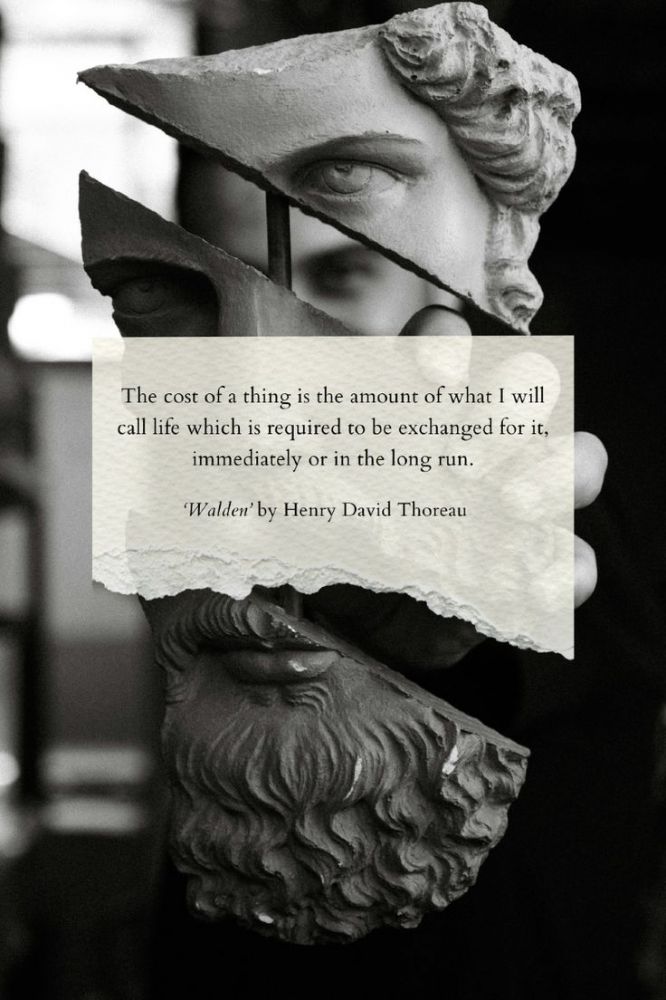
The quote from Henry David Thoreau’s Walden redefines "cost" from a financial metric to a biological and temporal one. It posits that the true price of any object or achievement is the portion of one's finite lifespan required to obtain it.
Primary Interpretation: Life as Currency
The fundamental premise is that money is merely a proxy for time. To earn money, an individual must expend "life"—measured in hours, energy, and mental focus. Therefore, when you purchase a "thing," you are not just spending currency; you are trading a non-renewable segment of your existence that you can never recover.
Secondary Interpretation: Immediate vs. Long-term Cost
Thoreau distinguishes between two types of expenditure:
-
Immediate: The direct labor or time spent to acquire the item.
-
Long-run: The ongoing "life" required to maintain, protect, or worry about the item after acquisition. A complex lifestyle requires more "life" to sustain, effectively indenturing the owner to their possessions.
Analysis of Logic
-
The Superior Perspective: Opportunity Cost The most robust way to apply this is through the lens of opportunity cost. Every hour spent working to buy a luxury is an hour stolen from leisure, relationships, or self-actualization. If the "thing" does not enhance your life more than the time lost to get it, it is a net deficit.
-
Alternative Perspective: Vital Capital A secondary framing is "Vital Capital." This views life energy as a finite bank account. In this model, physical exhaustion and stress are the "interest" paid on high-cost acquisitions, suggesting that some items are "too expensive" not because of their price tag, but because of the physiological toll they take on the buyer.
----------------
这段文字摘自亨利·戴维·梭罗的《瓦尔登湖》,它将“成本”从金融维度重新定义为生物与时间维度。其核心观点是:任何物品或成就的真实价格,是为了获得它而必须牺牲的那部分有限的生命。
核心解读:生命即货币
该论点的基础是:金钱仅仅是时间的代理。为了赚取金钱,个人必须消耗“生命”——这体现在时间、精力和精神专注力上。因此,当你购买一件“物品”时,你不仅是在消耗货币,更是在交易一段不可再生的生命,这段生命一旦流逝便无法挽回。
次要解读:即时成本与长期成本
梭罗区分了两种支出:
-
即时成本: 为获取该物品而直接投入的劳动或时间。
-
长期成本: 获取后,为维护、保护或担忧该物品而持续消耗的“生命”。复杂的生活方式需要更多的“生命”来维持,这实际上使所有者沦为了其财产的奴隶。
逻辑分析
-
最优视角:机会成本 应用这一观点最有力的方式是通过“机会成本”的视角。为了购买奢侈品而工作的每一小时,都是从休闲、人际关系或自我实现中偷走的一小时。如果该“物品”对生命的提升作用低于获取它所损失的时间价值,那么它就是一项净亏损。
-
备选视角:生命资本 另一种框架是“生命资本”。这种观点将生命能量视为一个有限的银行账户。在这种模型下,身体的疲惫和压力是为高成本收购支付的“利息”。这表明,有些东西之所以“太贵”,不是因为标价高,而是因为它们对购买者造成的生理和心理损耗过大。