Choose Strong
For Tim.



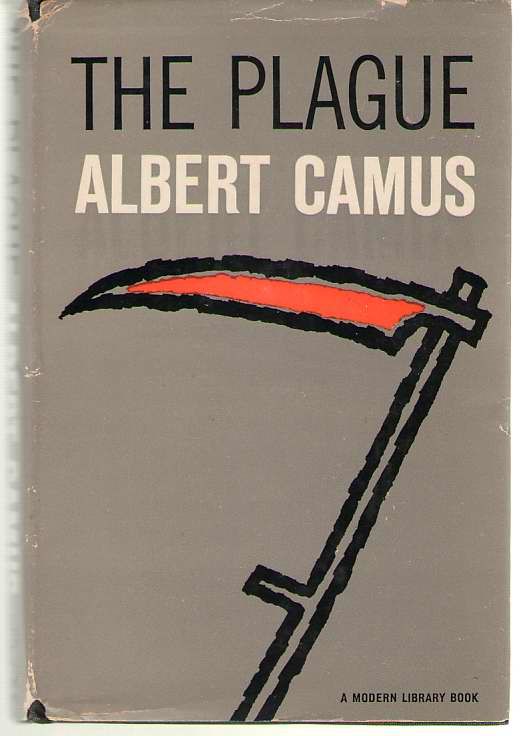
Mid-April, in the North African trading port Oran, folks were dismayed by rats
rushing out of their holes and dying in droves in the open, an ill omen that was
soon confirmed. In two weeks, Dr. Rieux had his first case of the bubonic
plague. His patient, the doorman, died in two days.
During the ensuing months, as the town took ever more draconian actions against
the staggering clamity, Dr. Rieux worked doggedly through the darkest hours
which at times felt like a never-ending defeat. He was joined by people like
Joseph Grand, an ascetic city clerk, Tarrou, a man who tried to live a saintly
life, Rambert, a reporter who gave up escaping to his wife, and Father Paneloux,
the learned and militant Jesuit priest. Each fought his own heroic battles and
had a story to tell.
For Dr. Rieux, one could not save lives and in the same breath understand the
grand scheme of things and had to attend to the more urgent. Abandoned by his
wife, Grand was obsessed with arriving at a perfect sentence which people would
look at and say "hats off!" Tarrou had broken with his father and tried to do no
harm or, in his own words, to "keep vigilance." Rambert almost succeeded in
leaving behind the doomed town before changing his mind, thinking "if he went
away, he would be shamed of himself and that would embarrass his relations with
the woman he loved" and "there was nothing shameful in preferring happiness but
it may be shameful to be happy by oneself." Father Paneloux first preached that
the scourge was divine punishment for people's "criminal indifference" to God
but after witnessing the death throes of an innocent child, he resolved that
there were no half measures in faith and, on his own death bed, saw calling a
doctor illogical for a priest.
Other impressive characters included Cottard the smuggler profiteering from the
collective misery, who as the plague receded went mad, and a 75-year old
asthmatic Spaniard, a former draper who quit working at age 50 and intended to
live to an advanced age.
I don't know how popular are heavy tales of epidemics but the author's elegant
prose carried the day, even for such a sombre subject. I know next to nothing
about French in which the novel was first written. English borrowed much from
that language, I understand, but if there was still any gap, the translator
Stuart Gilbert did a wonderful job in bridging it with delightful words and
phrases. I took 40 pages of notes of the 272-page book. (Compare with The
Alchemist which was 208 pages long and for which I took seven pages of notes.)