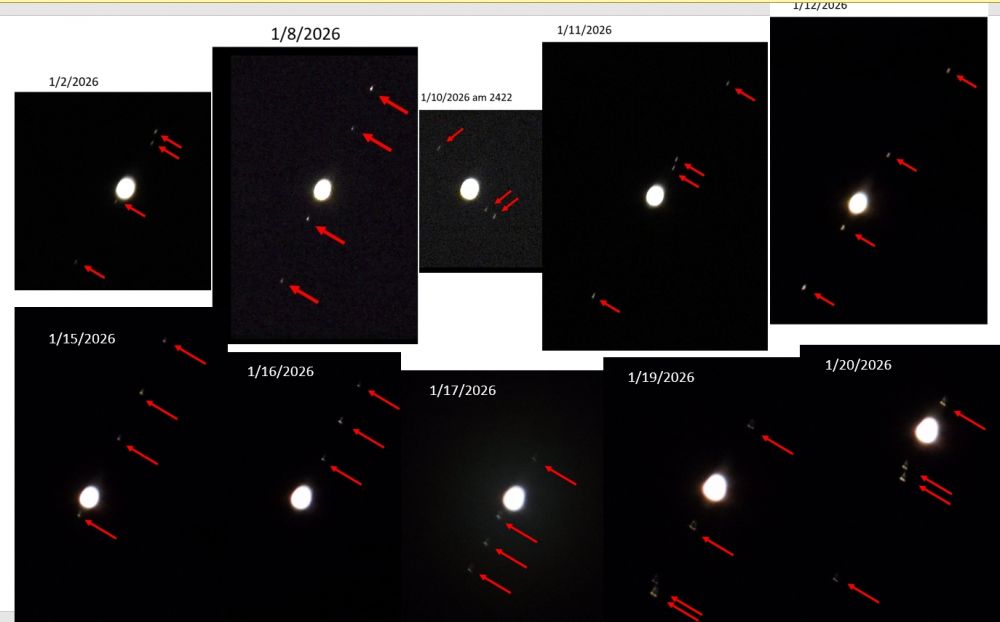



一个月份的木星和它的4个卫星
A brief introduction from gemini:
Meet the King of Planets: Jupiter
Jupiter is the undisputed heavyweight champion of our solar system. As a gas giant, it doesn't have a solid surface you could stand on; instead, it's a massive ball of hydrogen and helium with a turbulent atmosphere of colorful clouds and ancient storms.
Fast Facts
-
Size: It is so large that 1,300 Earths could fit inside it.
-
The Great Red Spot: A persistent, high-pressure storm larger than Earth that has been raging for at least 350 years.
-
Speed: Despite its size, Jupiter spins incredibly fast, completing a "day" in just under 10 hours.
-
Moons: It has 95 confirmed moons. The four largest—Io, Europa, Ganymede, and Callisto—are known as the Galilean moons and can be seen with simple binoculars.
Jupiter in January 2026: The Best Seat in the House
January 2026 is an extraordinary month for observing Jupiter because the planet reaches opposition on January 10, 2026.
What is Opposition?
Opposition occurs when Earth passes directly between the Sun and Jupiter. This configuration makes Jupiter appear at its largest and brightest for the entire year.
Viewing Highlights for January 2026
-
Peak Brightness: Throughout the month, Jupiter shines at a brilliant magnitude of -2.7, making it the brightest "star-like" object in the night sky (since Venus is mostly hidden by the Sun's glare this month).
-
Location: You can find it in the constellation Gemini, positioned near the "Twin" stars, Castor and Pollux.
-
All-Night Visibility: Because it is opposite the Sun, Jupiter rises in the east at sunset, climbs high in the south around midnight, and sets in the west at sunrise.
-
Celestial Meetups: * January 9: Jupiter is at its closest point to Earth (perigee), roughly 393 million miles away.
-
January 30–31: The nearly full Snow Moon will appear very close to Jupiter, creating a stunning visual pairing for naked-eye observers and photographers.
-
Tips for Observers
-
Binoculars: You can easily spot the four Galilean moons as tiny pinpoints of light flanking the planet.
-
Telescope: A modest telescope will reveal Jupiter’s dark atmospheric bands (the North and South Equatorial Belts) and potentially the Great Red Spot.
deepseek把Gemini的英文翻译成了中文:
木星:行星之王
木星是我们太阳系当之无愧的"重量级冠军"。作为一颗气态巨行星,它没有可供站立的固态表面;相反,它是一个由氢和氦组成的巨大球体,拥有由多彩云层和古老风暴构成的狂暴大气。
关键信息
大小: 其体积巨大,足以容纳下1300个地球。
大红斑: 一个比地球还大的持久高压风暴,已肆虐至少350年。
自转速度: 尽管体型庞大,木星自转却快得惊人,一个"木星日"仅需不到10小时。
卫星: 目前已确认拥有95颗卫星。其中最大的四颗——木卫一(伊奥)、木卫二(欧罗巴)、木卫三(盖尼米得)和木卫四(卡利斯托)——被称为伽利略卫星,用普通双筒望远镜即可看到。
2026年1月观测木星:黄金时机
2026年1月是观测木星的绝佳月份,因为木星将在2026年1月10日 迎来"冲日"。
什么是"冲日"?
当地球恰好运行到太阳和木星之间时,即发生"冲日"。此时,木星看起来是一年中最明亮、视直径最大的时刻。
2026年1月观测亮点
亮度巅峰: 整个1月,木星将以-2.7等 的灿烂光芒闪耀夜空,成为夜空中最明亮的"类星"天体(因为本月金星大多隐没在太阳的光芒中)。
位置: 它位于双子座,靠近"双子星"——北河二(Castor)和北河三(Pollux)。
整夜可见: 由于与太阳相对,木星在日落后于东方升起,午夜前后高悬于南方天空,日出时于西方落下。
天象奇观: * 1月9日: 木星运行到距离地球最近的位置(近地点),约3.93亿英里。
* 1月30日至31日: 近乎满月的"雪月"将出现在木星附近,为肉眼观测者和摄影师呈现一场令人惊叹的视觉奇观。
给观测者的建议
双筒望远镜: 可以轻易看到四颗伽利略卫星,如同木星两侧的几个微小光点。
天文望远镜: 一架普通望远镜就能揭示木星上的深色大气带(北赤道带和南赤道带),甚至可能看到大红斑。
1/2/2026 - 2/2/2026